
The Motor House
The Motor House in North Yorkshire is a rare site where several major traditions in British art, architecture, and cultural thought converge. Rooted in the Arts & Crafts movement and shaped by successive generations of influential artists, it has functioned as a place of making, collaboration, and experimental practice for over forty years. Its significance lies both in its architectural heritage and in the artistic lineage associated with the Bell and Richmond families, linking figures including John Ruskin, William Morris, Philip Webb, William Blake Richmond, and David Bomberg.
The site’s history begins with the industrialist Sir Lowthian Bell (1816–1904), who purchased the Rounton estate in 1866. Bell had already worked extensively with the architect Philip Webb, a central figure in the Arts & Crafts movement and close associate of William Morris. Webb designed several buildings for the Bell family, including Red Barns at Redcar and works offices at Port Clarence. Following his first visit to Rounton, Webb proposed an entirely new house to replace the existing Rounton Grange. Construction began in 1872 and was completed in 1876, creating one of the most important Arts & Crafts houses in Britain.
Rounton Grange later became home to Hugh and Florence Bell and their daughter Gertrude Bell (1868–1926) — traveller, archaeologist, and founder of the Iraq Museum in Baghdad. After her death in 1926, the family moved to Mount Grace Priory, a former Carthusian monastery on the estate acquired on the advice of Morris and Webb. Rounton Grange was used as a military hospital during the Second World War and demolished in the early 1950s. Today, Rounton retains outstanding examples of Arts & Crafts architecture, including Webb’s buildings, George Jack’s later designs, and extensive walled gardens.
The Motor House, built in 1905 by George Jack, Philip Webb’s assistant and successor, formed part of this wider architectural vision. Originally designed to house the Bell family’s motor cars, the building contained six garages on the ground floor and living quarters for the chauffeur’s family above. Adjacent outbuildings include the Fowl House — originally part of Rounton Grange and remodelled by Webb as stabling — now used as workshop space. Five of the original garages have since been converted into artists’ studios, and the complex provides substantial indoor and outdoor working areas. It remains one of the most important surviving buildings of the Rounton estate.
The cultural significance of Rounton is also inseparable from the Richmond family, whose artistic lineage reflects a continuous tradition in British art. The miniature painter Thomas Richmond (1771–1837) was followed by his son George Richmond (1809–1896), one of William Blake’s circle of young artists known as The Ancients. George Richmond met John Ruskin in Rome in 1840, beginning a lifelong friendship. His son, William Blake Richmond, later succeeded Ruskin as Slade Professor of Fine Art at Oxford in 1878 and completed the mosaics of St Paul’s Cathedral in 1904.
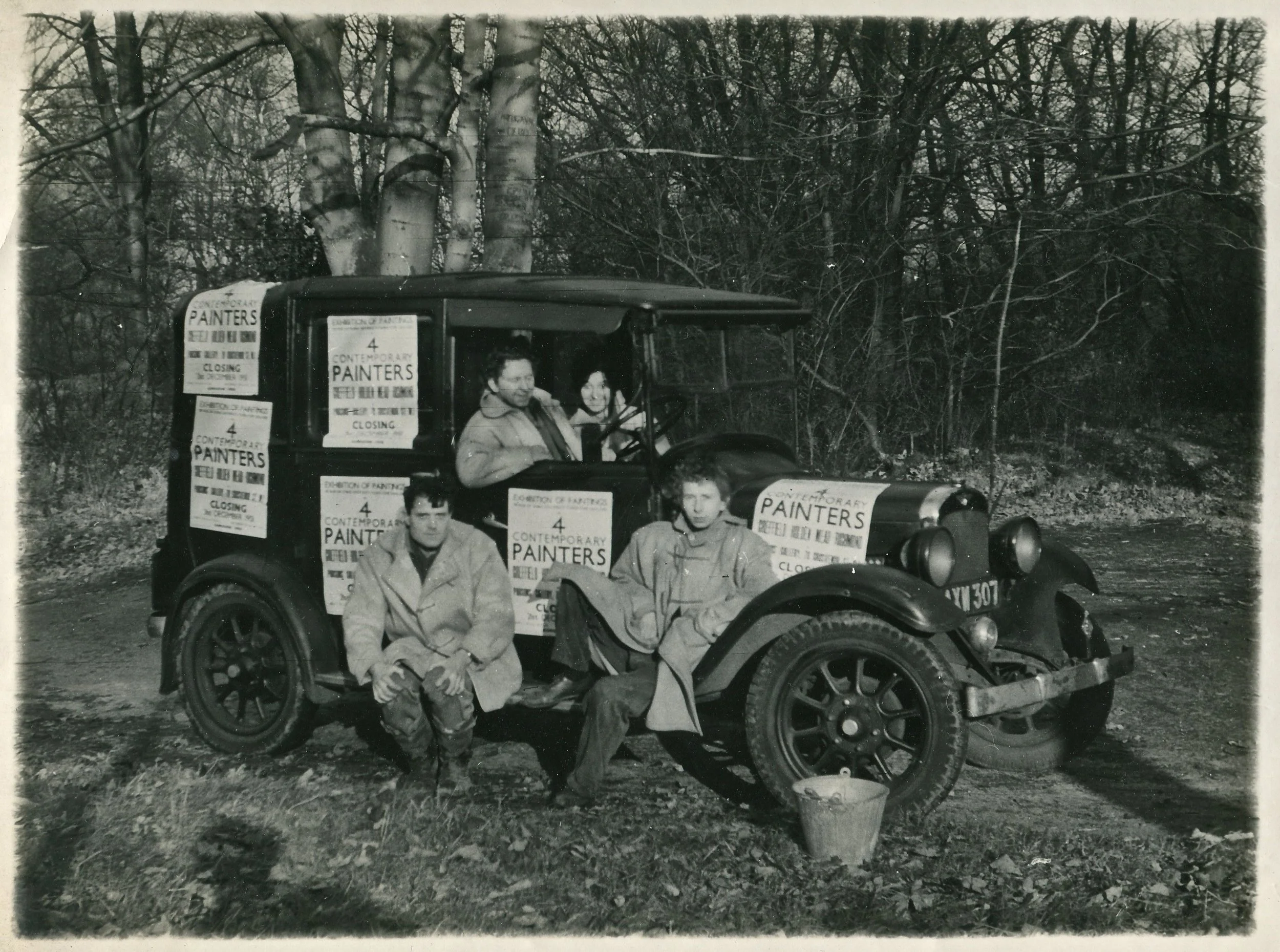
This artistic inheritance continued into the twentieth century with Miles Richmond (1923–2008) and Susanna Richmond, both pupils and close collaborators of the painter David Bomberg (1890–1957). They studied with Bomberg at the Borough Polytechnic in London in the late 1940s as part of the Borough Group, and later lived near him in Ronda, Spain, until his death in 1957. Bomberg’s teaching sought to reconcile modernity with artistic tradition, drawing on influences that included Walter Sickert, Henry Tonks at the Slade School, and the educational ideals of William Lethaby, founder of the Central School of Arts and Crafts in 1896.
After many years in Spain, Miles and Susanna Richmond returned to England in 1977, and in 1980 Miles moved to The Motor House. In the early 1980s the building was repurposed by the Richmond family — including the painter David Seaton — as a working studio environment. The first workshop was held there in 1982, led by the influential educator Harry Thubron. From 1981 to 2000, the site hosted workshops with the University of Hertfordshire, and in 1996 it worked with the Rietveld Academy in Amsterdam, alongside collaborations with Teesside University and other visiting groups.
Through these activities, The Motor House became an important centre for artistic production, offering space for work at scale and across media. It embodies the legacy of Bomberg’s teaching, the Arts & Crafts philosophy of Ruskin, Morris, and Webb, and a continuing commitment to making as a collaborative and experimental practice. As a surviving Arts & Crafts building and a living site of artistic exchange, The Motor House represents a unique convergence of British architectural heritage and modern artistic tradition.

